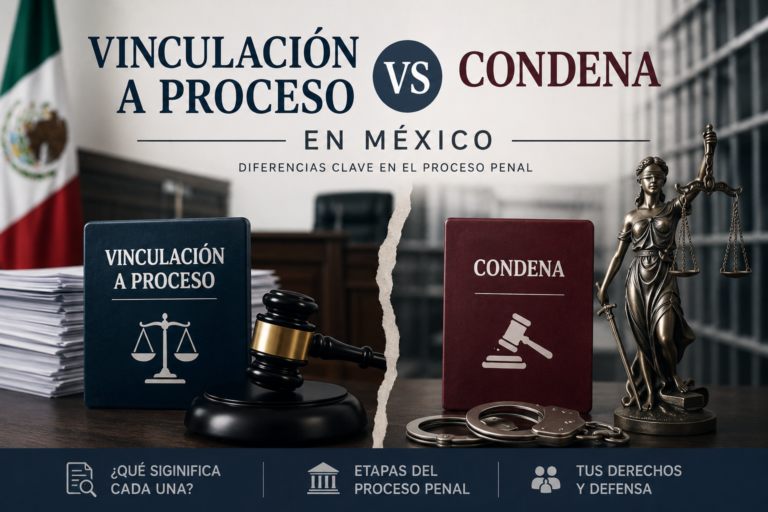
Mexico Accusatory System Indictment vs Conviction
Mexico’s 2016 criminal justice reform introduced one of the most significant overhauls of the country’s legal system in decades. The new accusatory (adversarial) system replaced the largely written, inquisitorial process with an oral, adversarial model closer to international standards.

One of the central features of this new system is a clear separation between the preliminary stages of a criminal proceeding and the final determination of guilt. For international professionals, investors, and due diligence practitioners, understanding this separation is essential to accurately interpreting publicly available information about individuals involved in Mexican criminal proceedings.
Stage 1: The Binding-Over Order
The binding-over order — known in Spanish as the auto de vinculación a proceso — is a preliminary judicial decision issued by a Control Judge at the outset of a criminal proceeding. Its purpose is narrow: to determine whether there are reasonable grounds to believe that a crime was committed and that the defendant may have played a role.
Article 316 of Mexico’s National Code of Criminal Procedures sets out the requirements: a formal charge must have been made, the defendant must have had the opportunity to respond, and there must be evidentiary data indicating that a crime occurred and that the defendant possibly participated.
Critically, Mexico’s Supreme Court has clarified that this standard does not require proof of guilt. The binding-over order simply authorizes the investigation to continue under judicial supervision — it is not a determination of guilt, a finding of probable cause in the US sense, or a finding that the defendant committed the alleged acts.
Stage 2: The Intermediate Stage
Following the binding-over order, the case enters an intermediate stage in which the prosecution prepares a formal accusation (escrito de acusación). This is the stage where charges are finalized, evidence is reviewed, and the defense has the opportunity to challenge the prosecution’s case before the matter proceeds to trial.
Many cases in Mexico’s accusatory system are resolved at this stage — either because the prosecution withdraws charges, because the defense successfully challenges the legal basis for the accusation, or because the parties reach an agreement. The intermediate stage is, in practice, a significant filter between preliminary proceedings and full criminal trial.
Stage 3: The Trial and Final Verdict
The trial stage is where guilt or innocence is ultimately determined. Mexico’s accusatory system requires that all evidence be presented and challenged in open oral hearings before a panel of three judges. The standard of proof — beyond reasonable doubt — is the same standard applied in most common law jurisdictions.
Only a final verdict issued at the conclusion of the trial stage constitutes a conviction. Everything that precedes it — including the binding-over order, cautelary measures, and even the formal accusation — is preliminary in nature and carries no finding of guilt.
This framework means that a person can be formally charged, subject to cautelary measures, and publicly associated with ongoing criminal proceedings for months or years — and ultimately be acquitted, or have the proceedings dismissed, without ever having been convicted of anything.
The Amparo as a Check on Preliminary Proceedings
Mexico’s constitutional framework includes an additional layer of protection: the juicio de amparo. When a binding-over order or other preliminary ruling fails to meet constitutional standards — for example, because the charges are generic and fail to identify specific individual conduct, or because the prosecution’s legal theory lacks a coherent causal structure — the defendant can petition a federal court to review and overturn it.
A federal court that grants an amparo in this context has made a formal constitutional determination that the preliminary proceedings were deficient. This is not a finding of innocence — but it is a finding that the government did not follow the constitutional rules that govern criminal proceedings in Mexico.
Implications for Professional Due Diligence For professionals conducting due diligence on individuals involved in Mexican criminal proceedings, the key questions are not whether a binding-over order was issued, but rather:
• Has the case resulted in a final conviction?
• Have federal courts reviewed the preliminary proceedings and found them constitutionally sound?
• Were the charges formulated with the specificity required by Mexico’s Constitution?
• Has the individual complied with all procedural obligations during the proceedings?
These questions provide a far more accurate picture of an individual’s legal standing than a search result referencing early-stage proceedings.